 United States
Four Problems Every SMB Knows
One Answer: So Smart.
Let’s be honest: most American small and midsize businesses today live with four major headaches that slow growth and keep owners up at night. And the numbers back it up: according to the FBI Internet Crime Complaint Center (IC3), Americans reported nearly $21 billion in cybercrime losses in 2025 — the highest total ever recorded. Meanwhile, the 2025 Verizon Data Breach Investigations Report found that ransomware or extortion appears in 88% of breaches at small businesses, versus just 39% at large enterprises. Translation: SMBs are now the preferred target.
Problem #1 — On-Premises Hardware
Physical servers in a back room (or worse, in a closet next to the copier). UPS units to replace. Aging hard drives. Operating systems to patch. Licenses to renew. An IT consultant to call every time something breaks.
The result? High fixed costs, poor scalability, unpredictable downtime. A business that, instead of focusing on its market and customers, has to spend time, money, and energy managing infrastructure that isn’t its core competency.
And when it’s time to open a new location, let sales reps work from home, or grant data access to an outside contractor, you run into flaky VPNs, slow performance, and complicated configurations.
Problem #2 — Cybersecurity
Ransomware, phishing, data theft, CCPA, HIPAA, SOC 2. Cybersecurity can no longer be deferred, but it’s genuinely difficult for an SMB to maintain in-house the skills, tools, and 24/7 monitoring required to keep pace with today’s threats.
Backups done “when somebody remembers,” passwords shared over chat, untracked access, personal devices used for work with no controls. One wrong click on a single email is all it takes to shut a company down for days — with major financial and reputational damage. The Verizon DBIR reports a median loss of $46,000 per breach, with the worst cases running into the millions.
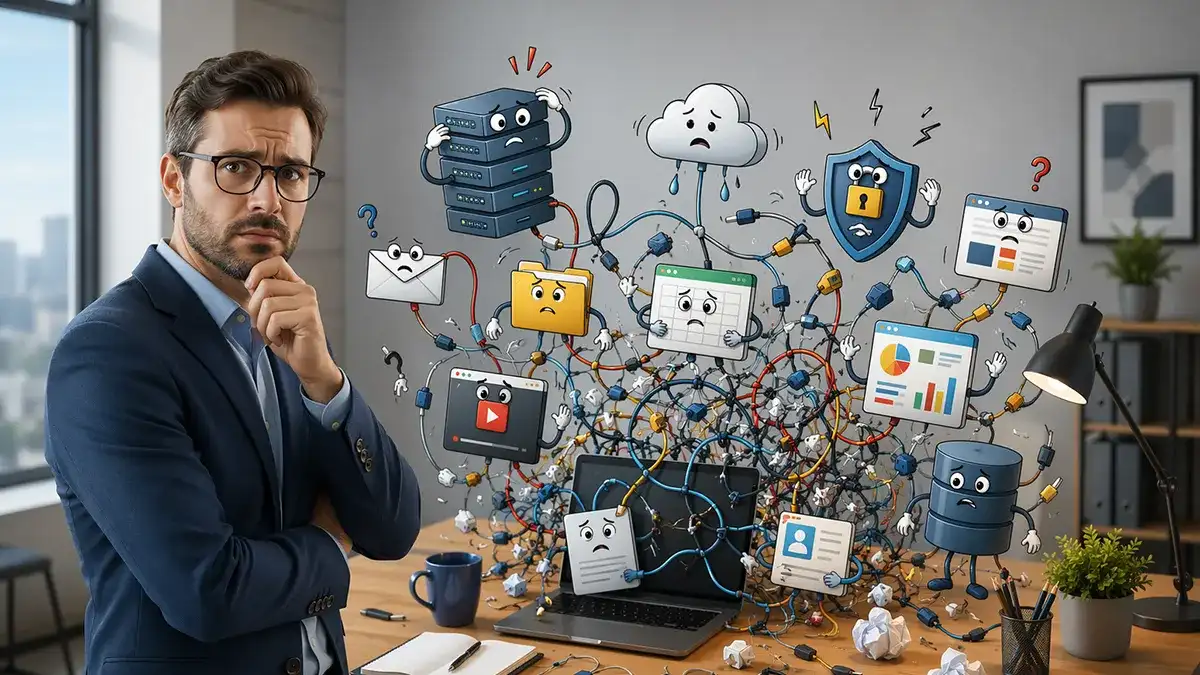
Problem #3 — A Dozen Apps That Don’t Talk to Each Other
The ERP from one vendor. The CRM from another. Payroll software from a third. An e-commerce platform from yet another. Plus Excel, Outlook, Slack, Dropbox, QuickBooks, Trello, Google Drive…
Every department has its own tools. Every tool has its own data. Nothing talks to anything. The result: duplicate records, mismatched information, hours wasted copy-pasting between systems, errors, late decisions because “a piece is always missing.”
Integrations are expensive, break on the next update, and need constant maintenance. The dream of “a single source of truth” stays just a dream.
Problem #4 — Too Many Vendors, No Single Owner
When something breaks, the finger-pointing begins: “That’s an ERP issue” → “No, it’s the email provider” → “No, it’s the network” → “No, it’s the CRM” → “No, it’s the ISP.”
Every vendor watches their own piece. No one watches the whole. The owner becomes, against their will, the conductor of an orchestra in which every musician is reading a different score.
What businesses actually want is one accountable partner — one that understands the business, knows the technology, and takes ownership of the entire digital project end-to-end.
So here’s the real question: is it still worth tackling all of this alone?
The Answer: One Ecosystem, One Partner, One Platform
So Smart is not “just” an ERP built on Microsoft Dynamics 365 Business Central. It’s the front door to the entire Microsoft cloud ecosystem — the same platform that protects and powers millions of businesses, governments, banks, and hospitals around the world every day.
Choosing So Smart solves all four problems at once.
✓ Goodbye, on-premises hardware
Everything runs on Microsoft Azure, with US-based datacenters, geographic redundancy, automatic backups, and continuous updates with zero service interruptions. No servers to buy, maintain, or replace. Costs become predictable, and the infrastructure scales with your business.
Microsoft also offers contractual service-level agreements (SLAs) of up to 99.99% uptime on its cloud services.
✓ Enterprise-grade security, even for an SMB
Microsoft has announced an investment of $20 billion over five years in cybersecurity. With So Smart, your business inherits this automatically: MFA, encryption, anti-ransomware, 24/7 monitoring, and compliance frameworks. MFA alone blocks more than 99.2% of account compromise attempts.
✓ One integrated ecosystem
- Microsoft Dynamics 365 Business Central — operations
- Microsoft 365 — productivity tools
- Power BI — analytics
- Power Platform — automations
- Microsoft Copilot — AI
Everything is already integrated. The single source of truth actually exists.
✓ One accountable partner: the So Smart team
One partner across the whole journey: analysis, go-live, training, support, evolution.
One team. One owner. One number to call.
FAQ — Frequently Asked Questions
Why do many small and mid-sized businesses still have on‑premises servers and infrastructure?
Many companies have built their infrastructure over time, adding servers and systems as they grew. Often there was never a dedicated moment to rethink the overall architecture, and what worked years ago has now become a limitation in terms of costs, scalability, and business continuity.
What is the real cybersecurity risk for a small or mid-sized business?
The main risk is not just the attack itself, but its operational impact: business downtime, data loss, blocked production, or administrative paralysis. Even a single phishing email can cause significant damage if proper controls, reliable backups, and structured procedures are missing.
Why does using many different applications create problems?
When each department uses tools that are not integrated, data becomes fragmented. Information is duplicated, updated manually, and often not aligned. This slows down daily work and makes it harder to make decisions based on reliable numbers.
What does it mean not to have a “single source of truth” in a company?
It means there is no shared and reliable version of information. Sales, accounting, and production may work with different numbers, leading to errors, misunderstandings, and wasted time spent verifying which data is correct.
Why is having too many IT vendors a problem?
Each vendor tends to focus only on their own area. When a cross-functional issue arises, it becomes difficult to identify the root cause and resolve it quickly. The company ends up managing coordination itself, without a single partner truly responsible for the overall system.
Is a modern management system suitable for small and mid-sized businesses?
Yes. Today, modern management platforms are designed also for smaller organizations. They do not require large upfront investments in hardware and allow companies to grow over time, adding functionality only when it is truly needed.
What is the main advantage of an integrated ecosystem?
The main advantage is information continuity. All departments work on the same data, updated in real time, reducing errors, manual activities, and waiting times. This frees up resources and improves decision quality.
So Smart is the fastest and easiest way to enter the world of Microsoft Dynamics 365 Business Central. The solution that helps you automate processes, monitor data in real time, produce analytical reports and monitor compliance. So Smart is the cloud solution that can be accessed from any browser anywhere around the world. The system can be accessed from your computer, smartphone or tablet simply by installing the app. Now you can manage your business anywhere at your convenience, and it is 100 percent secure with the Microsoft Azure Cloud network.