 United States
Cash Flow Forecasting: Predict Liquidity for SMBs
Cash Flow Forecasting: How SMBs Can Predict Liquidity Using Real Data
Most small and mid-sized businesses check liquidity the same way: by looking at the bank account balance. It’s the quickest signal available, but it carries a structural limit — the balance only reflects what has already happened. It tells you how much cash you have today, not what will happen two weeks from now.
Yet the information about the future is already in the business: in customer and vendor due dates, in open entries, in posted documents. The challenge isn’t the data itself, but the ability to read it forward. That’s exactly what cash flow forecasting does: it turns operational numbers into a reliable view of future liquidity.
Why cash flow forecasting is a business goal, not an accounting exercise
Financial forecasting drives concrete decisions every day:
- payment planning for vendors and payroll
- short-term operational choices
- the strength of relationships with suppliers and banks
Without a reliable forecast, decisions become reactive and driven by urgency. With solid cash flow management, you plan ahead and negotiate from a position of strength.
The limits of manual forecasting in spreadsheets
In most small and mid-sized businesses, cash flow planning lives inside a hand-built spreadsheet. It works, but it has three weaknesses that make it fragile:
- it takes time to update every single time
- it goes stale fast: every new invoice or shifted due date throws the whole sheet out of sync
- it’s not connected to real ERP data, so it’s exposed to errors and omissions
For many businesses, the real leap isn’t calculating cash flow — it’s monitoring it while the company operates.
From operational data to financial forecasting: the role of the ERP
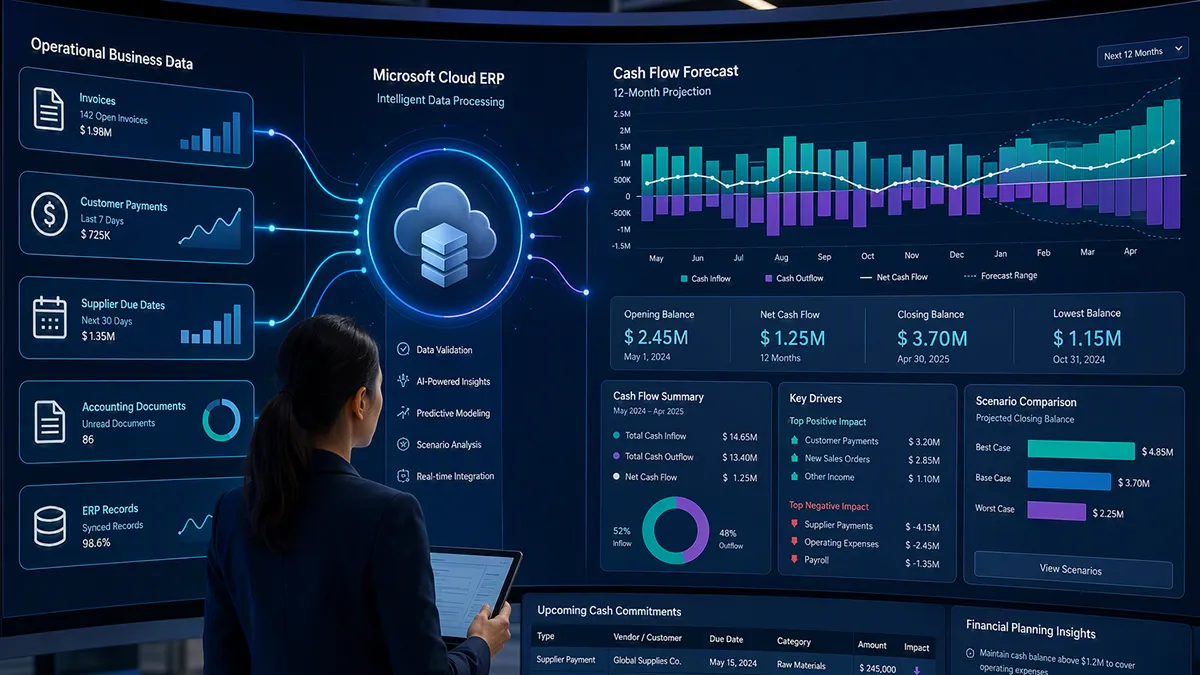
With an ERP for SMBs, the forecast stops being an estimate and becomes a reading of data already in the system. So Smart, the preconfigured solution built on Microsoft Dynamics 365 Business Central, builds the cash flow forecast from:
- real due dates from customers and vendors
- open entries and posted documents
- planned and recurring movements
The result is a forward-looking view of liquidity that updates on its own as the business moves. No more spreadsheets to rebuild — just a tool that stays aligned with reality.
4 benefits of cash flow forecasting built on real data
- Greater visibility into future liquidity, beyond today’s balance
- Fewer reactive decisions and more deliberate payment planning
- Quick scenarios: add a movement and instantly see its impact on cash
- Fewer financial surprises, because variances are caught early
Power BI: the executive view of liquidity over time
Alongside the cash flow forecast in Business Central, Power BI integrated in So Smart delivers a faster, executive-level reading. It lets you visualize liquidity trends over time, compare periods, and change the analysis horizon. It’s especially useful for owners and leadership teams who need to make decisions quickly.
In summary
Building a cash flow forecast comes down to one simple idea: turn the data you already have into a reliable financial view you can base decisions on. You don’t need new data or complex estimates — you need to read what your ERP records every day in the right way. With So Smart and Microsoft Dynamics 365 Business Central, cash flow forecasting shifts from a snapshot of the past to a real lever for running the business.
Watch the video 👇
FAQ — Cash flow forecasting for SMBs
What is cash flow forecasting?
It’s the projection of a company’s future cash flows, built from due dates, open entries, and planned movements. Unlike the bank balance, which captures the past, cash flow forecasting shows what will happen to liquidity in the coming days and weeks.
Why isn’t the bank balance enough to manage liquidity?
Because the balance only reflects what has already happened. To plan payments and operational decisions, you need a forward-looking forecast that reads the data already in your ERP.
How do you forecast cash flow without a spreadsheet?
With an ERP for SMBs like Microsoft Dynamics 365 Business Central, the forecast is generated automatically from real data: customer and vendor due dates, open entries, and planned movements — no spreadsheets to update by hand.
Which companies benefit most from cash flow management?
Any small or mid-sized business working with variable margins and collection times — services, distribution, manufacturing, and e-commerce — where even small liquidity swings quickly affect operations.
Do you need dedicated cash flow forecasting software?
Cash flow forecasting software integrated into your ERP is the most reliable option, because it removes the gap between accounting data and the forecast and keeps everything updated in real time.
So Smart is the fastest, simplest way into the world of Microsoft Dynamics 365 Business Central. The solution that helps you automate processes, monitor data in real time, and produce analytical reports. So Smart is a cloud solution accessible from any browser, 100% secure on the Microsoft Azure Cloud network